


How can silicone RFID waterproof wristbands for swimming pools balance reading sensitivity with resistance to metal/water interference, ensuring stable identification at the poolside?
Release Time : 2026-02-11
In high-humidity environments such as swimming pools, water parks, hot springs, and saunas, personnel management poses stringent challenges to equipment reliability. As a smart wearable terminal integrating identity recognition, access control, and even mobile payment, silicone RFID waterproof wristbands for swimming pools must maintain fast and stable signal reading performance even under complex electromagnetic environments involving prolonged contact with water, chlorine, sweat, and proximity to metal facilities. However, water and metal are precisely the two major "enemies" of RFID technology—water absorbs high-frequency electromagnetic waves, while metal reflects and shields signals.
1. Antenna Design: Water- and Metal-Resistant "Isolated" Layout
Traditional RFID antennas are prone to resonant frequency shifts in water due to changes in dielectric constant, while near metal, the signal is significantly attenuated due to eddy current effects. To address this, the swimming-specific silicone wristband employs a dual strategy of "avoiding metal + impedance matching." First, the RFID chip and antenna module are embedded inside the wristband, away from the skin and metal contact surfaces. A flexible ferrite or nanocrystalline magnetic shielding film is added to the back of the antenna to effectively block electromagnetic interference from metal objects below. Second, the antenna uses a customized ring or folded dipole structure. Its electrical characteristics in a wet environment are precisely calculated using simulation software to pre-compensate for frequency drift, ensuring efficient coupling of reader energy in the 13.56MHz or 860–960MHz frequency bands.
2. Packaging Process: Fully Sealed Silicone Encapsulation to Isolate from Moisture Corrosion
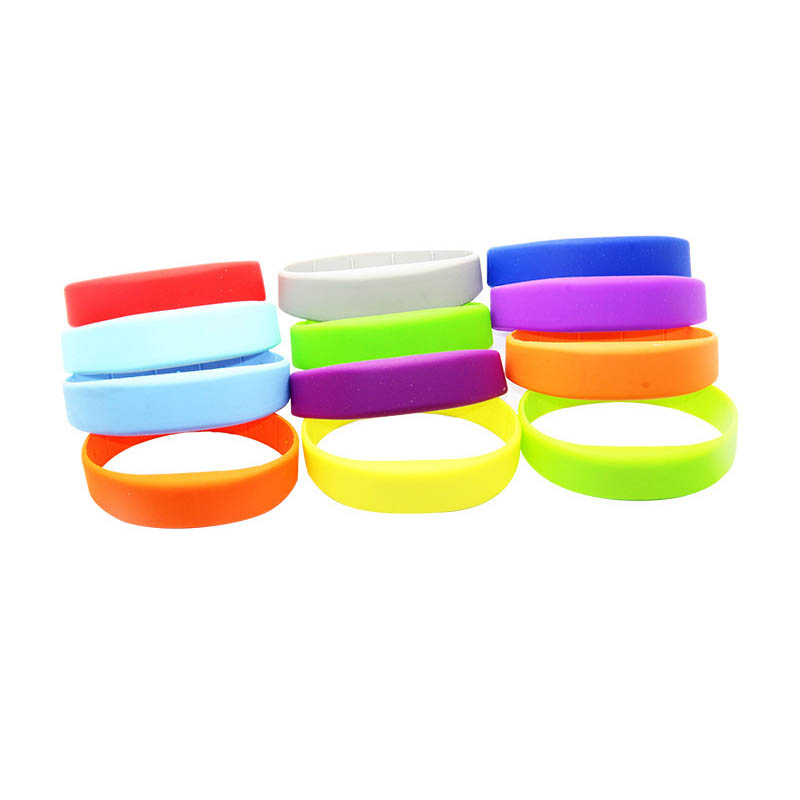
Silicone itself has excellent hydrophobicity and chemical stability, but if the encapsulation is not tight, moisture can still seep in along the chip pins or antenna solder joints, causing short circuits or corrosion. High-end swimming wristbands use a one-piece injection molding process, completely encapsulating the RFID inlay in medical-grade liquid silicone without any seams or gaps. Some products also introduce "double-layer encapsulation" technology: the inner layer is a low-dielectric-constant buffer adhesive to protect the circuit, and the outer layer is a high-elasticity silicone to provide mechanical protection.
3. Frequency and Protocol Optimization: Selecting the Most Suitable Communication Solution for Wet Environments
Different RFID frequency bands exhibit significantly different sensitivities to water. While UHF signals have a long reading distance, they attenuate extremely quickly in water; HF/NFC, with their longer wavelengths, have stronger penetration in wet environments, making them more suitable for close-range identification scenarios. Therefore, swimming wristbands generally use NFC Forum Type 2/4 or ISO14443 standard chips, coupled with high-Q antenna designs, achieving millisecond-level response within a 2–5cm range of the reader. Simultaneously, a retransmission mechanism and signal strength adaptive algorithm are incorporated into the protocol layer, automatically increasing transmission power or extending the communication window when a reading failure is detected, effectively addressing transient interference.
4. System-Level Collaboration: Joint Optimization of Reader and Wristband
Stable identification relies not only on the wristband's capabilities but also on collaboration with the reader/writer. At pool entrances, dedicated NFC readers are often equipped with directional antennas and metal backplate isolation designs, focusing energy on the wristband area; simultaneously, the system software uses reasonable anti-collision algorithms and sensitivity thresholds to prevent missed reads due to multiple people passing through simultaneously. Some high-end solutions also incorporate a "wake-up-response" mechanism: the reader first sends a low-power detection signal, and only activates full-power communication when the wristband enters the effective area, saving energy and reducing false triggers.
In summary, silicone RFID waterproof wristbands for swimming pools, through anti-interference antenna design, fully sealed silicone encapsulation, frequency band strategy optimization, and system-level collaboration, successfully overcome the dual suppression of RFID signals by water and metal. While ensuring wearing comfort and aesthetic customization, they achieve highly reliable identification in harsh environments such as swimming pools, providing a solid technical foundation for smart venue management.
1. Antenna Design: Water- and Metal-Resistant "Isolated" Layout
Traditional RFID antennas are prone to resonant frequency shifts in water due to changes in dielectric constant, while near metal, the signal is significantly attenuated due to eddy current effects. To address this, the swimming-specific silicone wristband employs a dual strategy of "avoiding metal + impedance matching." First, the RFID chip and antenna module are embedded inside the wristband, away from the skin and metal contact surfaces. A flexible ferrite or nanocrystalline magnetic shielding film is added to the back of the antenna to effectively block electromagnetic interference from metal objects below. Second, the antenna uses a customized ring or folded dipole structure. Its electrical characteristics in a wet environment are precisely calculated using simulation software to pre-compensate for frequency drift, ensuring efficient coupling of reader energy in the 13.56MHz or 860–960MHz frequency bands.
2. Packaging Process: Fully Sealed Silicone Encapsulation to Isolate from Moisture Corrosion
Silicone itself has excellent hydrophobicity and chemical stability, but if the encapsulation is not tight, moisture can still seep in along the chip pins or antenna solder joints, causing short circuits or corrosion. High-end swimming wristbands use a one-piece injection molding process, completely encapsulating the RFID inlay in medical-grade liquid silicone without any seams or gaps. Some products also introduce "double-layer encapsulation" technology: the inner layer is a low-dielectric-constant buffer adhesive to protect the circuit, and the outer layer is a high-elasticity silicone to provide mechanical protection.
3. Frequency and Protocol Optimization: Selecting the Most Suitable Communication Solution for Wet Environments
Different RFID frequency bands exhibit significantly different sensitivities to water. While UHF signals have a long reading distance, they attenuate extremely quickly in water; HF/NFC, with their longer wavelengths, have stronger penetration in wet environments, making them more suitable for close-range identification scenarios. Therefore, swimming wristbands generally use NFC Forum Type 2/4 or ISO14443 standard chips, coupled with high-Q antenna designs, achieving millisecond-level response within a 2–5cm range of the reader. Simultaneously, a retransmission mechanism and signal strength adaptive algorithm are incorporated into the protocol layer, automatically increasing transmission power or extending the communication window when a reading failure is detected, effectively addressing transient interference.
4. System-Level Collaboration: Joint Optimization of Reader and Wristband
Stable identification relies not only on the wristband's capabilities but also on collaboration with the reader/writer. At pool entrances, dedicated NFC readers are often equipped with directional antennas and metal backplate isolation designs, focusing energy on the wristband area; simultaneously, the system software uses reasonable anti-collision algorithms and sensitivity thresholds to prevent missed reads due to multiple people passing through simultaneously. Some high-end solutions also incorporate a "wake-up-response" mechanism: the reader first sends a low-power detection signal, and only activates full-power communication when the wristband enters the effective area, saving energy and reducing false triggers.
In summary, silicone RFID waterproof wristbands for swimming pools, through anti-interference antenna design, fully sealed silicone encapsulation, frequency band strategy optimization, and system-level collaboration, successfully overcome the dual suppression of RFID signals by water and metal. While ensuring wearing comfort and aesthetic customization, they achieve highly reliable identification in harsh environments such as swimming pools, providing a solid technical foundation for smart venue management.